

TREATMENT DETAIL
Zirconia
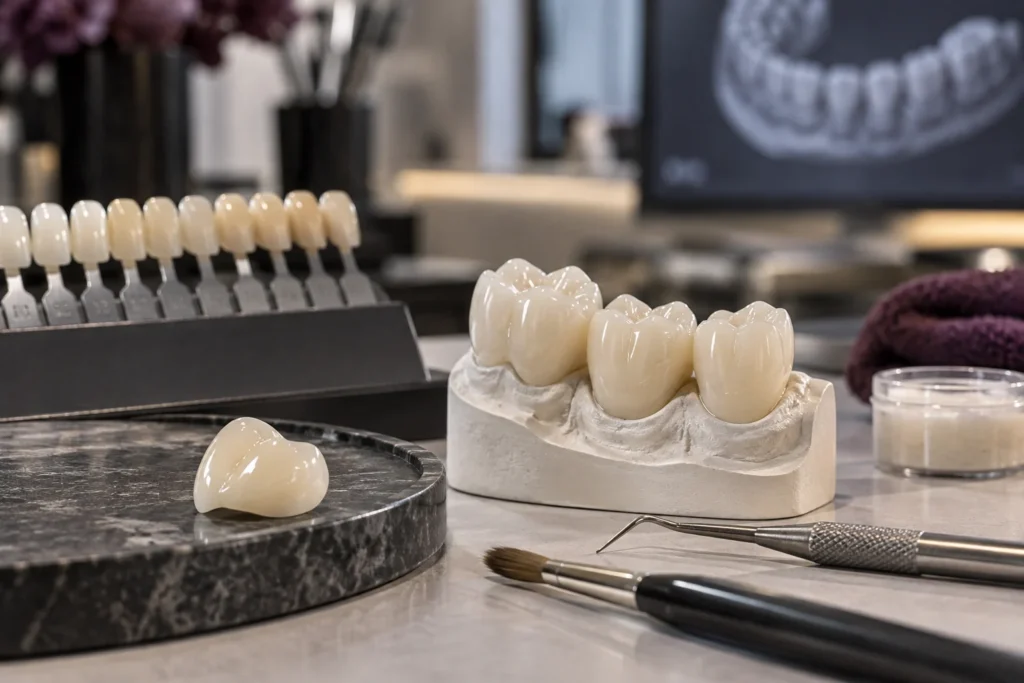
Fixed restoration prepared using metal-free zirconia framework or monolithic zirconia; planned according to color, form, support, and occlusion requirements.
OVERVIEW
Metal-free fixed restoration option.
Zirconia crown can be evaluated according to clinical conditions in cases of extensive tooth structure loss, specific discolorations, missing tooth bridges, and implant-supported restorations.
The grey shadow caused by the metal margin seen in metal-fused porcelains is not present in zirconia; however, gum recession or other causes of discoloration may still occur. Zirconia can be used in single crowns, selected bridges, and implant-supported teeth. It can mask the appearance of limited crowding but does not move teeth orthodontically; to prevent unnecessary loss of tooth structure, orthodontics and more conservative options are evaluated first. In precision-attached removable or hybrid dentures, a metal framework may be preferred by design. The same type and thickness of zirconia are not used for every patient.
01
DIGITAL EVALUATION
02
PERSONALIZED PLANNING
EVALUATION
How is suitability determined?
Treatment selection is made by evaluating clinical examination, necessary imaging, and personal expectations together.
01
Tooth tissue and color
Caries, cracks, old restorations, root canal treatment, and substrate color are examined.
02
Gums and aesthetic margin
Gingival margin level, biotype, smile line, and restoration margin are planned.
03
Occlusion and design
Bruxism, bridge span, implant position, and prosthetic attachment are evaluated.
“The decision for zirconia is based not only on expectations of whiteness, but on tooth structure, gums, bridge span, and occlusion.”
Dr. Ediz Cem Türk
TREATMENT PROCESS
Step by step process
01
Diagnosis and options
Alternatives such as teeth whitening, bonding, veneers, or orthodontics are discussed alongside crown requirements.
02
Preparation and digital impression
The required amount of tooth preparation is performed and impressions are taken.
03
Try-in
Marginal fit, color, shape, contacts, and occlusion are evaluated.
04
Cementation and maintenance
The restoration is fixed; interdental cleaning and follow-up care plans are explained.
FREQUENTLY ASKED QUESTIONS
Detailed answers
It is a fixed restoration prepared from zirconia-based ceramics to replace lost tooth structure or complete a missing tooth gap.
A zirconia crown is a fixed restoration prepared using zirconia-based ceramics. Since it contains no metal framework, it does not create a grey shadow associated with metal margins; however, periodontal health and the appearance of the natural root color can still have an impact. It can be used on single teeth, selected bridges, and implants. The masking of very dark underlying structures depends on the material thickness and type. Although it can alter the appearance of crowding to a limited extent, it does not correct the root position of the teeth. Metal frameworks may be required in precision-attached removable dentures. Bruxism, bridge length, remaining tooth structure, and aesthetic goals determine the choice of material.
It can be evaluated in suitable candidates with extensive loss of tooth structure, discoloration that needs masking, or requirements for bridge or implant-supported teeth.
A zirconia crown is a fixed restoration prepared using zirconia-based ceramics. Since it contains no metal framework, it does not create a grey shadow associated with metal margins; however, periodontal health and the appearance of the natural root color can still have an impact. It can be used on single teeth, selected bridges, and implants. The masking of very dark underlying structures depends on the material thickness and type. Although it can alter the appearance of crowding to a limited extent, it does not correct the root position of the teeth. Metal frameworks may be required in precision-attached removable dentures. Bruxism, bridge length, remaining tooth structure, and aesthetic goals determine the choice of material.
Tooth tissue, roots, root canal treatments, gums, color, occlusion, bruxism, and bridge span are examined.
A zirconia crown is a fixed restoration prepared using zirconia-based ceramics. Since it contains no metal framework, it does not create a grey shadow associated with metal margins; however, periodontal health and the appearance of the natural root color can still have an impact. It can be used on single teeth, selected bridges, and implants. The masking of very dark underlying structures depends on the material thickness and type. Although it can alter the appearance of crowding to a limited extent, it does not correct the root position of the teeth. Metal frameworks may be required in precision-attached removable dentures. Bruxism, bridge length, remaining tooth structure, and aesthetic goals determine the choice of material.
It progresses through tooth preparation, digital or conventional impressions, temporary teeth, try-in, cementation, and follow-up stages.
A zirconia crown is a fixed restoration prepared using zirconia-based ceramics. Since it contains no metal framework, it does not create a grey shadow associated with metal margins; however, periodontal health and the appearance of the natural root color can still have an impact. It can be used on single teeth, selected bridges, and implants. The masking of very dark underlying structures depends on the material thickness and type. Although it can alter the appearance of crowding to a limited extent, it does not correct the root position of the teeth. Metal frameworks may be required in precision-attached removable dentures. Bruxism, bridge length, remaining tooth structure, and aesthetic goals determine the choice of material.
Pain is controlled during preparation using local anesthesia; mild temporary sensitivity or gum discomfort may occur afterwards.
A zirconia crown is a fixed restoration prepared using zirconia-based ceramics. Since it contains no metal framework, it does not create a grey shadow associated with metal margins; however, periodontal health and the appearance of the natural root color can still have an impact. It can be used on single teeth, selected bridges, and implants. The masking of very dark underlying structures depends on the material thickness and type. Although it can alter the appearance of crowding to a limited extent, it does not correct the root position of the teeth. Metal frameworks may be required in precision-attached removable dentures. Bruxism, bridge length, remaining tooth structure, and aesthetic goals determine the choice of material.
Depending on the number of teeth, laboratory fabrication, and try-in requirements, the process may span several appointments.
A zirconia crown is a fixed restoration prepared using zirconia-based ceramics. Since it contains no metal framework, it does not create a grey shadow associated with metal margins; however, periodontal health and the appearance of the natural root color can still have an impact. It can be used on single teeth, selected bridges, and implants. The masking of very dark underlying structures depends on the material thickness and type. Although it can alter the appearance of crowding to a limited extent, it does not correct the root position of the teeth. Metal frameworks may be required in precision-attached removable dentures. Bruxism, bridge length, remaining tooth structure, and aesthetic goals determine the choice of material.
In cases with very long bridge spans, insufficient support, active disease, or removable denture attachments, alternative materials may be required.
A zirconia crown is a fixed restoration prepared using zirconia-based ceramics. Since it contains no metal framework, it does not create a grey shadow associated with metal margins; however, periodontal health and the appearance of the natural root color can still have an impact. It can be used on single teeth, selected bridges, and implants. The masking of very dark underlying structures depends on the material thickness and type. Although it can alter the appearance of crowding to a limited extent, it does not correct the root position of the teeth. Metal frameworks may be required in precision-attached removable dentures. Bruxism, bridge length, remaining tooth structure, and aesthetic goals determine the choice of material.
Fracture, debonding, marginal leakage, decay, sensitivity, gum recession, or color mismatch may occur.
A zirconia crown is a fixed restoration prepared using zirconia-based ceramics. Since it contains no metal framework, it does not create a grey shadow associated with metal margins; however, periodontal health and the appearance of the natural root color can still have an impact. It can be used on single teeth, selected bridges, and implants. The masking of very dark underlying structures depends on the material thickness and type. Although it can alter the appearance of crowding to a limited extent, it does not correct the root position of the teeth. Metal frameworks may be required in precision-attached removable dentures. Bruxism, bridge length, remaining tooth structure, and aesthetic goals determine the choice of material.
Interdental spaces and area under bridges should be cleaned, hard objects should not be bitten into, and check-ups should be maintained.
A zirconia crown is a fixed restoration prepared using zirconia-based ceramics. Since it contains no metal framework, it does not create a grey shadow associated with metal margins; however, periodontal health and the appearance of the natural root color can still have an impact. It can be used on single teeth, selected bridges, and implants. The masking of very dark underlying structures depends on the material thickness and type. Although it can alter the appearance of crowding to a limited extent, it does not correct the root position of the teeth. Metal frameworks may be required in precision-attached removable dentures. Bruxism, bridge length, remaining tooth structure, and aesthetic goals determine the choice of material.
Teeth whitening, bonding, veneers, orthodontics, porcelain-fused-to-metal, or removable dentures can be evaluated based on clinical needs.
A zirconia crown is a fixed restoration prepared using zirconia-based ceramics. Since it contains no metal framework, it does not create a grey shadow associated with metal margins; however, periodontal health and the appearance of the natural root color can still have an impact. It can be used on single teeth, selected bridges, and implants. The masking of very dark underlying structures depends on the material thickness and type. Although it can alter the appearance of crowding to a limited extent, it does not correct the root position of the teeth. Metal frameworks may be required in precision-attached removable dentures. Bruxism, bridge length, remaining tooth structure, and aesthetic goals determine the choice of material.
EXAMINATION AND PLANNING
Let us evaluate the suitable option for you together.
The suitability of Zirconia Crown treatment for you can only be determined after clinical evaluation.