

TREATMENT DETAILS
Implant
A treatment designed to restore chewing function using an artificial root placed in the jawbone at the site of a missing tooth and a restoration made over it.
OVERVIEW
A combined assessment of the bone, general health, and final tooth plan.
An implant is an artificial tooth root that can support a fixed or removable prosthesis in cases involving one missing tooth, multiple missing teeth, or complete tooth loss.
In selected cases, an implant can be placed at the same time as a tooth extraction. When there is an acute infection, advanced bone loss, or insufficient primary stability, healing after extraction may be required first. Diabetes, medications, smoking, periodontal health, and bone condition are assessed; the HbA1c value helps evaluate treatment risk, but it is not a universal acceptance or rejection threshold on its own, and the patient’s physician is consulted when necessary. Implant loading and completion of the final tooth may be planned on different schedules ranging from approximately three weeks to six months; the timing depends on the implant surface, bone, stability, and general health.
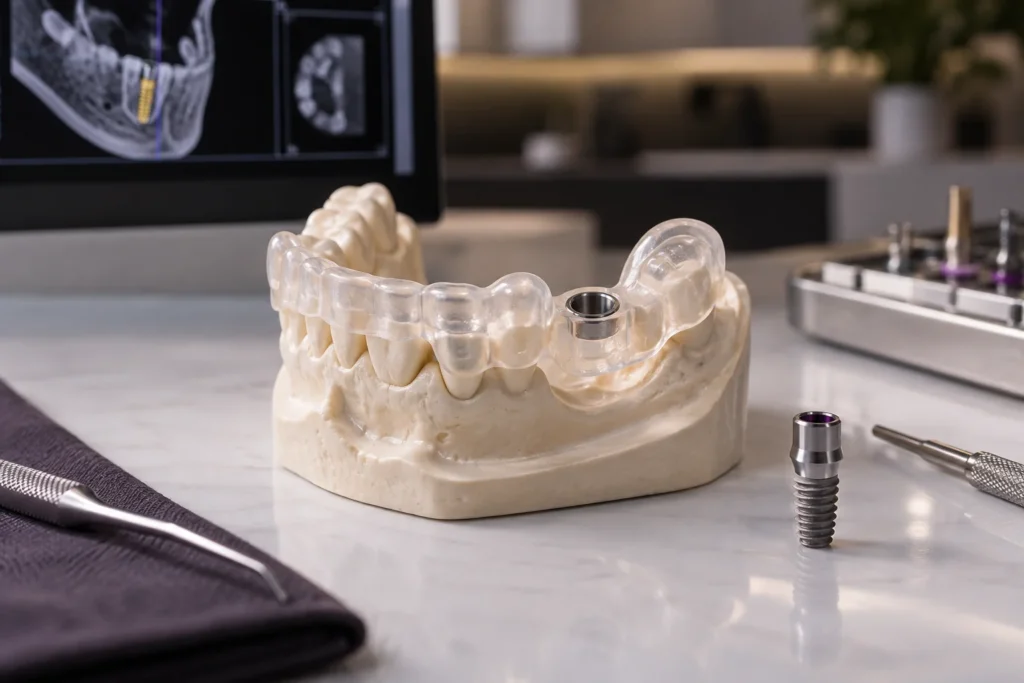
01
DIGITAL ASSESSMENT
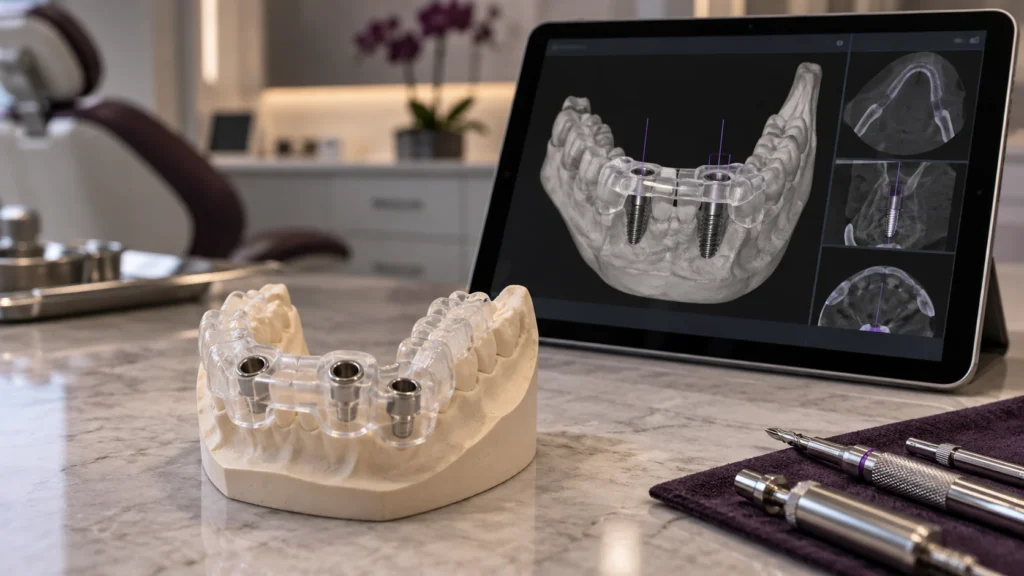
02
PERSONALIZED PLANNING
ASSESSMENT
How is suitability determined?
The treatment is selected by jointly evaluating the clinical examination, required imaging, and individual expectations.
01
General health
Diabetes control, medications, smoking, conditions that affect healing, and blood values when necessary are evaluated.
02
Bone and anatomy
Bone volume, nerves, sinuses, and adjacent roots are examined with tomography.
03
Prosthetic goal
The position, bite, and cleaning spaces of the tooth to be placed on the implant are planned.
“Implant selection and timing are planned according to bone conditions, general health, and the requirements of the final tooth—not according to brand.”
Dentist Ediz Cem Türk
TREATMENT PROCESS
The process step by step
01
Examination and imaging
Missing teeth, oral health, tomography, and medical history are evaluated.
02
Personalized plan
The number, size, and position of implants, surgical timing, and the need for additional procedures are determined.
03
Surgical procedure
The implant is placed under local anesthesia, and stability and the surrounding tissues are checked.
04
Healing and final tooth
Biological healing is monitored, and the impression and final restoration are completed at the appropriate time.
FREQUENTLY ASKED QUESTIONS
Detailed answers
It is a structure that mimics the root portion of a missing tooth and supports a prosthesis within the jawbone.
A dental implant is an artificial root placed in the jawbone. Suitability is determined by bone volume, infection, gum health, systemic conditions, medications, smoking, and the design of the final restoration. An implant may be placed at the same time as an extraction; however, if there is infection around the root or bone loss, the area may need to heal first. In patients with diabetes, HbA1c and overall metabolic control are evaluated together with the physician; a single value does not determine the decision for every patient. The healing or loading schedule may range from approximately three weeks to six months. A previous implant loss does not automatically make another implant either mandatory or contraindicated.
It may be considered for people with missing teeth who have completed their growth and whose general health, bone, and gum conditions have been evaluated.
A dental implant is an artificial root placed in the jawbone. Suitability is determined by bone volume, infection, gum health, systemic conditions, medications, smoking, and the design of the final restoration. An implant may be placed at the same time as an extraction; however, if there is infection around the root or bone loss, the area may need to heal first. In patients with diabetes, HbA1c and overall metabolic control are evaluated together with the physician; a single value does not determine the decision for every patient. The healing or loading schedule may range from approximately three weeks to six months. A previous implant loss does not automatically make another implant either mandatory or contraindicated.
Tomography, oral examination, periodontal status, medications, diabetes, smoking, and the prosthetic goal are reviewed.
A dental implant is an artificial root placed in the jawbone. Suitability is determined by bone volume, infection, gum health, systemic conditions, medications, smoking, and the design of the final restoration. An implant may be placed at the same time as an extraction; however, if there is infection around the root or bone loss, the area may need to heal first. In patients with diabetes, HbA1c and overall metabolic control are evaluated together with the physician; a single value does not determine the decision for every patient. The healing or loading schedule may range from approximately three weeks to six months. A previous implant loss does not automatically make another implant either mandatory or contraindicated.
The process consists of planning, surgical placement, healing, impressions, fabrication of the final tooth, and follow-up.
A dental implant is an artificial root placed in the jawbone. Suitability is determined by bone volume, infection, gum health, systemic conditions, medications, smoking, and the design of the final restoration. An implant may be placed at the same time as an extraction; however, if there is infection around the root or bone loss, the area may need to heal first. In patients with diabetes, HbA1c and overall metabolic control are evaluated together with the physician; a single value does not determine the decision for every patient. The healing or loading schedule may range from approximately three weeks to six months. A previous implant loss does not automatically make another implant either mandatory or contraindicated.
Local anesthesia controls pain during the procedure; temporary swelling, pain, and bruising may occur afterward.
A dental implant is an artificial root placed in the jawbone. Suitability is determined by bone volume, infection, gum health, systemic conditions, medications, smoking, and the design of the final restoration. An implant may be placed at the same time as an extraction; however, if there is infection around the root or bone loss, the area may need to heal first. In patients with diabetes, HbA1c and overall metabolic control are evaluated together with the physician; a single value does not determine the decision for every patient. The healing or loading schedule may range from approximately three weeks to six months. A previous implant loss does not automatically make another implant either mandatory or contraindicated.
Depending on the selected approach, the implant and final tooth timeline may range from approximately three weeks to six months.
A dental implant is an artificial root placed in the jawbone. Suitability is determined by bone volume, infection, gum health, systemic conditions, medications, smoking, and the design of the final restoration. An implant may be placed at the same time as an extraction; however, if there is infection around the root or bone loss, the area may need to heal first. In patients with diabetes, HbA1c and overall metabolic control are evaluated together with the physician; a single value does not determine the decision for every patient. The healing or loading schedule may range from approximately three weeks to six months. A previous implant loss does not automatically make another implant either mandatory or contraindicated.
Uncontrolled systemic conditions, insufficient bone, active infection, or inadequate oral care must be addressed first.
A dental implant is an artificial root placed in the jawbone. Suitability is determined by bone volume, infection, gum health, systemic conditions, medications, smoking, and the design of the final restoration. An implant may be placed at the same time as an extraction; however, if there is infection around the root or bone loss, the area may need to heal first. In patients with diabetes, HbA1c and overall metabolic control are evaluated together with the physician; a single value does not determine the decision for every patient. The healing or loading schedule may range from approximately three weeks to six months. A previous implant loss does not automatically make another implant either mandatory or contraindicated.
Infection, nerve or sinus involvement, failure of the implant to integrate with the bone, and prosthetic complications may occur.
A dental implant is an artificial root placed in the jawbone. Suitability is determined by bone volume, infection, gum health, systemic conditions, medications, smoking, and the design of the final restoration. An implant may be placed at the same time as an extraction; however, if there is infection around the root or bone loss, the area may need to heal first. In patients with diabetes, HbA1c and overall metabolic control are evaluated together with the physician; a single value does not determine the decision for every patient. The healing or loading schedule may range from approximately three weeks to six months. A previous implant loss does not automatically make another implant either mandatory or contraindicated.
Brushing, interdental cleaning tools, smoking control, and professional care are necessary for the health of the tissues around the implant.
A dental implant is an artificial root placed in the jawbone. Suitability is determined by bone volume, infection, gum health, systemic conditions, medications, smoking, and the design of the final restoration. An implant may be placed at the same time as an extraction; however, if there is infection around the root or bone loss, the area may need to heal first. In patients with diabetes, HbA1c and overall metabolic control are evaluated together with the physician; a single value does not determine the decision for every patient. The healing or loading schedule may range from approximately three weeks to six months. A previous implant loss does not automatically make another implant either mandatory or contraindicated.
A conventional bridge, removable denture, adhesive bridge, or monitoring the space may be considered depending on the clinical situation.
A dental implant is an artificial root placed in the jawbone. Suitability is determined by bone volume, infection, gum health, systemic conditions, medications, smoking, and the design of the final restoration. An implant may be placed at the same time as an extraction; however, if there is infection around the root or bone loss, the area may need to heal first. In patients with diabetes, HbA1c and overall metabolic control are evaluated together with the physician; a single value does not determine the decision for every patient. The healing or loading schedule may range from approximately three weeks to six months. A previous implant loss does not automatically make another implant either mandatory or contraindicated.
EXAMINATION AND PLANNING
Let us evaluate the right option for you together.
Whether implant treatment is suitable for you can only be determined after a clinical evaluation.