

TREATMENT DETAILS
Porcelain
A fixed restoration prepared with porcelain layered over a metal framework, where strength, occlusion, and denture attachment requirements are evaluated together. The type of crown to be made is determined individually for each patient.
OVERVIEW
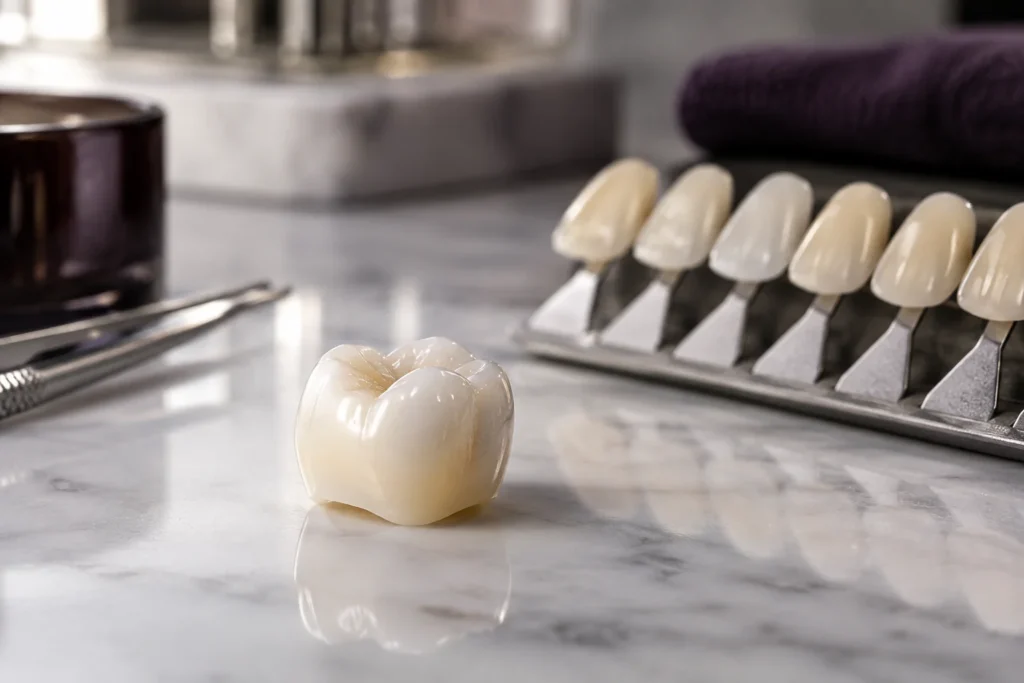
A restoration using a metal framework combined with a porcelain surface.
Metal-fused-to-porcelain crowns can still be used today in selected situations where mechanical requirements such as long bridges or denture attachments come to the forefront.
Zirconia is not the only option for every case. In long-span bridges, heavy chewing forces, and precision attachment sections of hybrid or removable partial dentures, metal-supported porcelain can be evaluated. The metal framework provides support to the restoration; the porcelain on top forms the tooth color and shape. In bruxism, no crown can be considered unbreakable; therefore, occlusion analysis and, if necessary, protective night guards are planned. The gum line, prevention of metal visibility, and cleanability are carefully checked during preparation and try-in stages.
01
DIGITAL EVALUATION
02
CUSTOM PLANNING
EVALUATION
How is suitability determined?
Treatment selection is made by evaluating clinical examination, necessary imaging, and personal expectations together.
01
Tooth and supporting tissue
Remaining tooth structure, roots, gums, and support of teeth serving as bridge abutments are examined.
02
Occlusion and bruxism
Chewing forces, signs of teeth clenching, and risk of porcelain fracture are evaluated.
03
Prosthesis design
Bridge span, removable denture attachments, cleaning areas, and aesthetic boundaries are determined.
“Crown material is selected not only for appearance, but based on bridge length, connection type, occlusion, and maintenance possibilities.”
Dr. Ediz Cem Türk
TREATMENT PROCESS
Step-by-step process
01
Planning
Clinical and radiographic evaluation is performed for crowns, bridges, or denture connections.
02
Preparation and impression
Teeth are prepared according to the planned material; digital or conventional impressions are taken.
03
Framework and porcelain try-in
Metal fit, margins, shade, shape, contacts, and bite are checked.
04
Cementation and follow-up
The restoration is cemented; oral hygiene, gum response, and occlusion are monitored during follow-ups.
FREQUENTLY ASKED
Detailed answers
It is a fixed restoration prepared by layering porcelain over a metal framework that restores lost tooth structure or missing tooth spans.
A metal-supported porcelain crown is a fixed restoration featuring a metal alloy inner core and a tooth-colored porcelain outer surface. It can be evaluated in situations such as long bridges, high mechanical requirements, or attachment to removable dentures. Which material is more durable compared to zirconia cannot be stated in a single sentence; bridge length, design, alloy type, porcelain thickness, and bite affect the outcome. A metal margin or framework may create a gray shadow under certain gum conditions. Bruxism can increase the risk of porcelain fracture; a metal framework does not completely eliminate this risk. Oral hygiene and cleaning beneath bridges are crucial for long-term follow-up.
It can be evaluated for individuals with extensive material loss, long bridge requirements, or removable denture connections, provided their supporting tissues are suitable.
A metal-supported porcelain crown is a fixed restoration featuring a metal alloy inner core and a tooth-colored porcelain outer surface. It can be evaluated in situations such as long bridges, high mechanical requirements, or attachment to removable dentures. Which material is more durable compared to zirconia cannot be stated in a single sentence; bridge length, design, alloy type, porcelain thickness, and bite affect the outcome. A metal margin or framework may create a gray shadow under certain gum conditions. Bruxism can increase the risk of porcelain fracture; a metal framework does not completely eliminate this risk. Oral hygiene and cleaning beneath bridges are crucial for long-term follow-up.
Tooth vitality, root and bone support, gums, occlusion, bruxism, and prosthesis design are examined.
A metal-supported porcelain crown is a fixed restoration featuring a metal alloy inner core and a tooth-colored porcelain outer surface. It can be evaluated in situations such as long bridges, high mechanical requirements, or attachment to removable dentures. Which material is more durable compared to zirconia cannot be stated in a single sentence; bridge length, design, alloy type, porcelain thickness, and bite affect the outcome. A metal margin or framework may create a gray shadow under certain gum conditions. Bruxism can increase the risk of porcelain fracture; a metal framework does not completely eliminate this risk. Oral hygiene and cleaning beneath bridges are crucial for long-term follow-up.
It proceeds through tooth preparation, impressions, metal framework try-in, porcelain try-in, cementation, and follow-up stages.
A metal-supported porcelain crown is a fixed restoration featuring a metal alloy inner core and a tooth-colored porcelain outer surface. It can be evaluated in situations such as long bridges, high mechanical requirements, or attachment to removable dentures. Which material is more durable compared to zirconia cannot be stated in a single sentence; bridge length, design, alloy type, porcelain thickness, and bite affect the outcome. A metal margin or framework may create a gray shadow under certain gum conditions. Bruxism can increase the risk of porcelain fracture; a metal framework does not completely eliminate this risk. Oral hygiene and cleaning beneath bridges are crucial for long-term follow-up.
Local anesthesia can be used during preparation; short-term gum or hot-cold sensitivity may be observed after the procedure.
A metal-supported porcelain crown is a fixed restoration featuring a metal alloy inner core and a tooth-colored porcelain outer surface. It can be evaluated in situations such as long bridges, high mechanical requirements, or attachment to removable dentures. Which material is more durable compared to zirconia cannot be stated in a single sentence; bridge length, design, alloy type, porcelain thickness, and bite affect the outcome. A metal margin or framework may create a gray shadow under certain gum conditions. Bruxism can increase the risk of porcelain fracture; a metal framework does not completely eliminate this risk. Oral hygiene and cleaning beneath bridges are crucial for long-term follow-up.
Multiple appointments are required depending on the number of teeth, bridge length, laboratory try-ins, and necessary adjustments.
A metal-supported porcelain crown is a fixed restoration featuring a metal alloy inner core and a tooth-colored porcelain outer surface. It can be evaluated in situations such as long bridges, high mechanical requirements, or attachment to removable dentures. Which material is more durable compared to zirconia cannot be stated in a single sentence; bridge length, design, alloy type, porcelain thickness, and bite affect the outcome. A metal margin or framework may create a gray shadow under certain gum conditions. Bruxism can increase the risk of porcelain fracture; a metal framework does not completely eliminate this risk. Oral hygiene and cleaning beneath bridges are crucial for long-term follow-up.
In cases of insufficient supporting tissue, uncontrolled periodontal disease, or non-restorable teeth, other options are considered first.
A metal-supported porcelain crown is a fixed restoration featuring a metal alloy inner core and a tooth-colored porcelain outer surface. It can be evaluated in situations such as long bridges, high mechanical requirements, or attachment to removable dentures. Which material is more durable compared to zirconia cannot be stated in a single sentence; bridge length, design, alloy type, porcelain thickness, and bite affect the outcome. A metal margin or framework may create a gray shadow under certain gum conditions. Bruxism can increase the risk of porcelain fracture; a metal framework does not completely eliminate this risk. Oral hygiene and cleaning beneath bridges are crucial for long-term follow-up.
Porcelain chipping/fracture, marginal leakage, caries, gum irritation, gray shadows, or debonding of cement may occur.
A metal-supported porcelain crown is a fixed restoration featuring a metal alloy inner core and a tooth-colored porcelain outer surface. It can be evaluated in situations such as long bridges, high mechanical requirements, or attachment to removable dentures. Which material is more durable compared to zirconia cannot be stated in a single sentence; bridge length, design, alloy type, porcelain thickness, and bite affect the outcome. A metal margin or framework may create a gray shadow under certain gum conditions. Bruxism can increase the risk of porcelain fracture; a metal framework does not completely eliminate this risk. Oral hygiene and cleaning beneath bridges are crucial for long-term follow-up.
Under-bridge areas and interdental spaces should be cleaned with specialized brushes; if bruxism is present, the recommended protective night guard should be used.
A metal-supported porcelain crown is a fixed restoration featuring a metal alloy inner core and a tooth-colored porcelain outer surface. It can be evaluated in situations such as long bridges, high mechanical requirements, or attachment to removable dentures. Which material is more durable compared to zirconia cannot be stated in a single sentence; bridge length, design, alloy type, porcelain thickness, and bite affect the outcome. A metal margin or framework may create a gray shadow under certain gum conditions. Bruxism can increase the risk of porcelain fracture; a metal framework does not completely eliminate this risk. Oral hygiene and cleaning beneath bridges are crucial for long-term follow-up.
Zirconia, all-ceramic, onlay, endocrown, implant-supported restorations, or removable dentures can be evaluated according to clinical necessity.
A metal-supported porcelain crown is a fixed restoration featuring a metal alloy inner core and a tooth-colored porcelain outer surface. It can be evaluated in situations such as long bridges, high mechanical requirements, or attachment to removable dentures. Which material is more durable compared to zirconia cannot be stated in a single sentence; bridge length, design, alloy type, porcelain thickness, and bite affect the outcome. A metal margin or framework may create a gray shadow under certain gum conditions. Bruxism can increase the risk of porcelain fracture; a metal framework does not completely eliminate this risk. Oral hygiene and cleaning beneath bridges are crucial for long-term follow-up.
EXAMINATION AND PLANNING
Let’s evaluate the right option for you together.
The suitability of Porcelain Crown application for you can only be determined after clinical evaluation.