

TREATMENT DETAILS
Tooth
A whitening procedure aimed at lightening suitable discoloration on natural teeth, which can be applied with or without light assistance following a clinical examination.
OVERVIEW
Controlled lightening of natural tooth color.
In-office teeth whitening can usually be performed in a single session of about one hour in suitable patients; the number of sessions required varies depending on the source of discoloration and the response of the teeth.
The procedure can be planned with light assistance or using only whitening gel. The color of crowns, fillings, and implant-supported crowns will not lighten; only natural tooth structure is affected. Surface stains and dental calculus must be removed before the procedure, and existing caries and gum problems should be evaluated. For single-tooth darkening associated with amalgam, trauma, or root canal treatment, different approaches such as internal bleaching may be required instead of external whitening. Temporary tingling and gum sensitivity may occur.
01
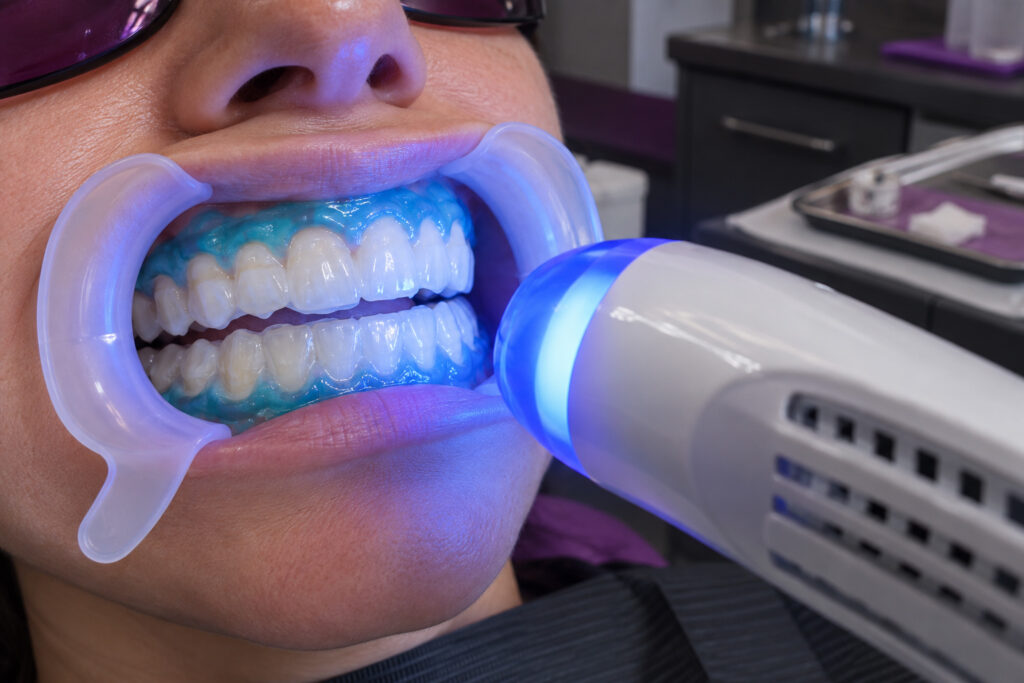
Solution and tissue protection
02
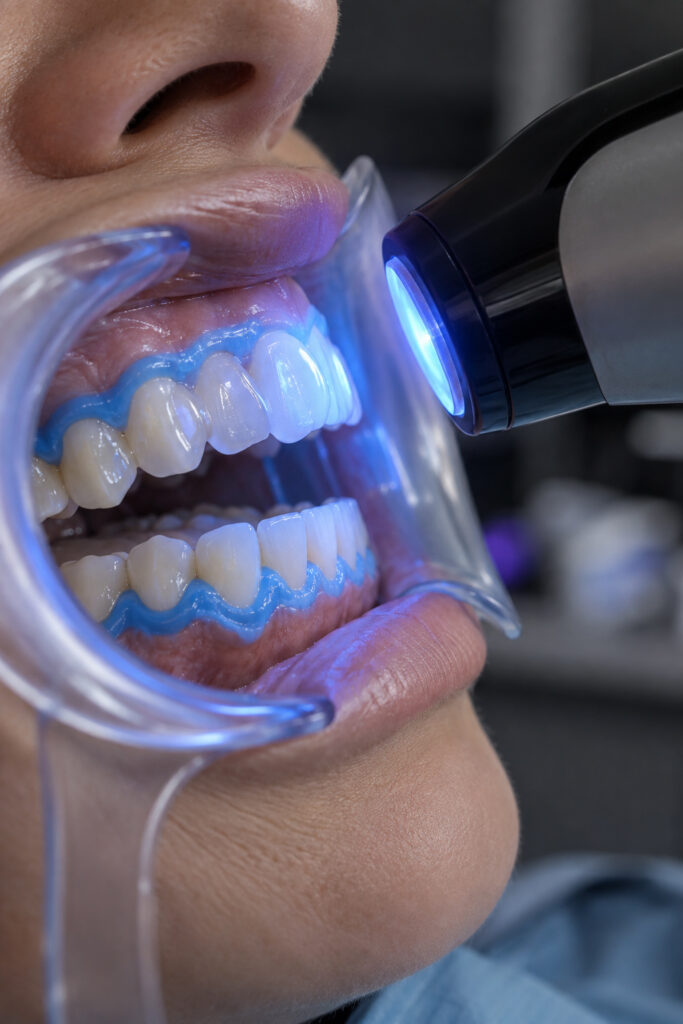
In-office light application
EVALUATION
How is suitability determined?
Treatment selection is made by evaluating clinical examination, necessary imaging, and personal expectations together.
01
Source of discoloration
Surface stains, age-related color changes, trauma, root canal treatment, and restorations are evaluated separately.
02
Oral health
Dental calculus, gingivitis, caries, cracks, and sensitivity are checked before the procedure.
03
Restorations
Since the color of crowns and fillings will not change, potential color differences are included in the treatment plan.
“A whitening plan begins by determining whether the discoloration is on the surface or inside the tooth.”
Dr. Ediz Cem Türk
TREATMENT PROCESS
Step-by-step process
01
Examination and cleaning
Teeth and gums are evaluated; dental calculus cleaning and surface stain removal are performed if necessary.
02
Tissue protection
Gums and surrounding soft tissues are protected from the whitening gel.
03
Gel application
The gel determined by the dentist is applied for controlled periods with or without light assistance.
04
Control and maintenance
Color change and sensitivity are evaluated; suitable personal care and stain control instructions are explained.
FREQUENTLY ASKED
Detailed answers
It is a procedure performed under dentist control using peroxide-containing agents to lighten the shade of suitable external and internal discolorations in natural teeth.
Whitening affects only the color of natural tooth structure. Porcelain, zirconia, composite fillings, and implant-supported restorations do not change color with whitening gel. Before the procedure, dental calculus, surface stains, caries, cracks, and gum health are evaluated. Clinical application can be performed with or without light assistance; the system used and contact duration are determined according to sensitivity history. Temporary sensitivity may occur. For internal discoloration in a single tooth, intracoronal bleaching may be considered after examining the condition of the root canal treatment.
It can be evaluated for individuals who have yellowing on their front teeth or natural teeth within the smile line, without active caries or uncontrolled gum disease.
Whitening affects only the color of natural tooth structure. Porcelain, zirconia, composite fillings, and implant-supported restorations do not change color with whitening gel. Before the procedure, dental calculus, surface stains, caries, cracks, and gum health are evaluated. Clinical application can be performed with or without light assistance; the system used and contact duration are determined according to sensitivity history. Temporary sensitivity may occur. For internal discoloration in a single tooth, intracoronal bleaching may be considered after examining the condition of the root canal treatment.
The cause of discoloration, sensitivity history, restorations, cracks, and gum health are examined; necessary cleaning is completed.
Whitening affects only the color of natural tooth structure. Porcelain, zirconia, composite fillings, and implant-supported restorations do not change color with whitening gel. Before the procedure, dental calculus, surface stains, caries, cracks, and gum health are evaluated. Clinical application can be performed with or without light assistance; the system used and contact duration are determined according to sensitivity history. Temporary sensitivity may occur. For internal discoloration in a single tooth, intracoronal bleaching may be considered after examining the condition of the root canal treatment.
Gums are protected, the gel is applied for designated intervals, and tooth tissue along with soft tissues are checked between each application interval.
Whitening affects only the color of natural tooth structure. Porcelain, zirconia, composite fillings, and implant-supported restorations do not change color with whitening gel. Before the procedure, dental calculus, surface stains, caries, cracks, and gum health are evaluated. Clinical application can be performed with or without light assistance; the system used and contact duration are determined according to sensitivity history. Temporary sensitivity may occur. For internal discoloration in a single tooth, intracoronal bleaching may be considered after examining the condition of the root canal treatment.
The procedure does not aim to cause pain; however, short-term tingling and sensitivity may develop during or after the application.
Whitening affects only the color of natural tooth structure. Porcelain, zirconia, composite fillings, and implant-supported restorations do not change color with whitening gel. Before the procedure, dental calculus, surface stains, caries, cracks, and gum health are evaluated. Clinical application can be performed with or without light assistance; the system used and contact duration are determined according to sensitivity history. Temporary sensitivity may occur. For internal discoloration in a single tooth, intracoronal bleaching may be considered after examining the condition of the root canal treatment.
Although an in-office session is often planned for approximately one hour, preparation, application protocol, and tooth response may alter the duration.
Whitening affects only the color of natural tooth structure. Porcelain, zirconia, composite fillings, and implant-supported restorations do not change color with whitening gel. Before the procedure, dental calculus, surface stains, caries, cracks, and gum health are evaluated. Clinical application can be performed with or without light assistance; the system used and contact duration are determined according to sensitivity history. Temporary sensitivity may occur. For internal discoloration in a single tooth, intracoronal bleaching may be considered after examining the condition of the root canal treatment.
Crowns and fillings do not whiten; planning may be postponed or altered in cases of pregnancy, severe sensitivity, active disease, or unsuitable types of discoloration.
Whitening affects only the color of natural tooth structure. Porcelain, zirconia, composite fillings, and implant-supported restorations do not change color with whitening gel. Before the procedure, dental calculus, surface stains, caries, cracks, and gum health are evaluated. Clinical application can be performed with or without light assistance; the system used and contact duration are determined according to sensitivity history. Temporary sensitivity may occur. For internal discoloration in a single tooth, intracoronal bleaching may be considered after examining the condition of the root canal treatment.
Temporary sensitivity, gum irritation, or color differences between natural teeth and existing restorations may occur.
Whitening affects only the color of natural tooth structure. Porcelain, zirconia, composite fillings, and implant-supported restorations do not change color with whitening gel. Before the procedure, dental calculus, surface stains, caries, cracks, and gum health are evaluated. Clinical application can be performed with or without light assistance; the system used and contact duration are determined according to sensitivity history. Temporary sensitivity may occur. For internal discoloration in a single tooth, intracoronal bleaching may be considered after examining the condition of the root canal treatment.
The toothpaste and brushing routine recommended by the dentist should be applied; recommendations regarding colored foods, beverages, and tobacco use should be followed individually.
Whitening affects only the color of natural tooth structure. Porcelain, zirconia, composite fillings, and implant-supported restorations do not change color with whitening gel. Before the procedure, dental calculus, surface stains, caries, cracks, and gum health are evaluated. Clinical application can be performed with or without light assistance; the system used and contact duration are determined according to sensitivity history. Temporary sensitivity may occur. For internal discoloration in a single tooth, intracoronal bleaching may be considered after examining the condition of the root canal treatment.
Professional cleaning for surface stains, internal bleaching for single-tooth darkening, and restorative options for appropriate aesthetic concerns can be evaluated.
Whitening affects only the color of natural tooth structure. Porcelain, zirconia, composite fillings, and implant-supported restorations do not change color with whitening gel. Before the procedure, dental calculus, surface stains, caries, cracks, and gum health are evaluated. Clinical application can be performed with or without light assistance; the system used and contact duration are determined according to sensitivity history. Temporary sensitivity may occur. For internal discoloration in a single tooth, intracoronal bleaching may be considered after examining the condition of the root canal treatment.
EXAMINATION AND PLANNING
Let’s evaluate the right option for you together.
The suitability of Tooth Whitening (Bleaching) application for you can only be determined after clinical evaluation.