

TREATMENT DETAILS
Suction
A removable complete denture approach aimed at providing retention through harmonious tissue borders and surface contact in complete edentulism.
OVERVIEW
Planning retention through tissue harmony in completely edentulous mouths.
Popularly referred to as a suction denture, this application utilizes impression and design principles intended to enhance the retention of a complete denture prepared for complete edentulism in the upper or lower jaw.
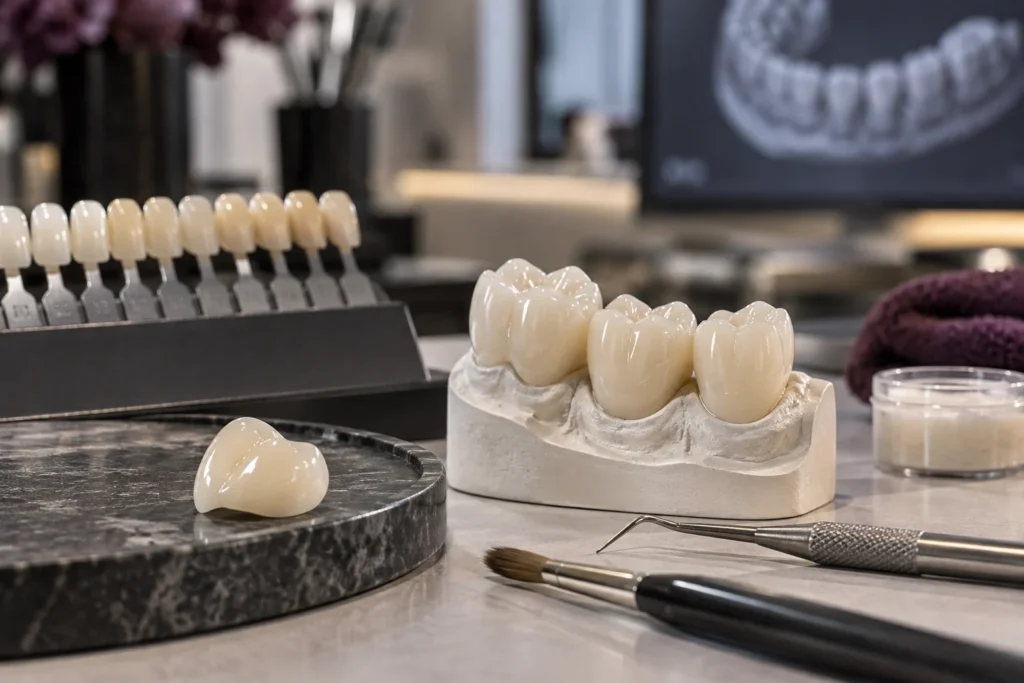
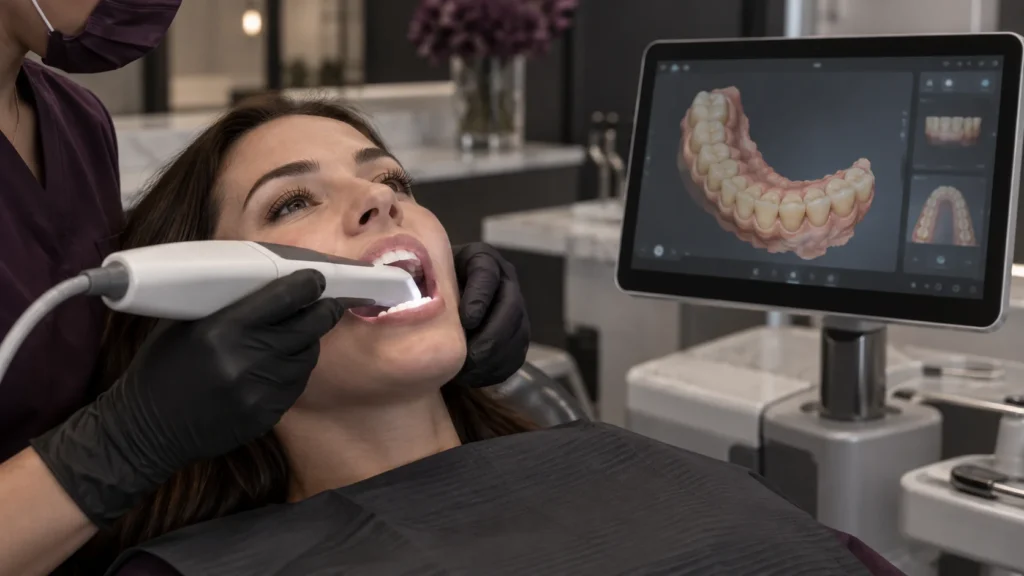
In individuals with advanced gum and jawbone loss, or whose existing denture moves while speaking or eating, oral anatomy is thoroughly evaluated. The suction effect is created through the combined interaction of denture border harmony with mobile tissues, palatal surface contact, saliva, and muscle control. However, the same level of retention may not be achieved in every patient, especially in the lower jaw or in cases of severe bone loss. Adding a suitable metal mesh inside the denture can reduce the risk of breakage, but does not eliminate it completely. The choice of acrylic, artificial teeth, and gum characterization is determined based on natural appearance, cleanability, and functional requirements.
01
DIGITAL EVALUATION
02
CUSTOM PLANNING
EVALUATION
How is suitability determined?
Treatment selection is made by evaluating clinical examination, necessary imaging, and personal expectations together.
01
Oral Tissues
Ridge height, palate contour, mobile mucosa, saliva, and sore spots are examined.
02
Existing Denture
Mobility, fractures, worn teeth, occlusion, speech, and cleaning issues are evaluated.
03
Alternative Support
If general health and bone conditions are suitable, the necessity of implant-supported options is also discussed.
“Retention in a complete denture comes not from a single material, but from accurate impressions, border molding, jaw relationships, and muscle harmony.”
Dr. Ediz Cem Türk
TREATMENT PROCESS
Step-by-step process
01
Preliminary and custom impression
Oral anatomy is recorded; a custom tray can be prepared for border molding.
02
Jaw relation
Vertical dimension, occlusion, lip support, and midline are determined.
03
Wax try-in
Tooth appearance, speech, and bite are checked before final completion.
04
Delivery and adaptation
Pressure spots are adjusted; insertion, removal, cleaning, and gradual usage are explained.
FREQUENTLY ASKED
Detailed answers
It is a removable complete denture that aims to provide retention through tissue harmony and peripheral seal in a completely edentulous jaw.
The term suction denture is mostly used for complete dentures whose retention is enhanced through detailed impressions and border molding; it is not a distinct formal denture classification. The adhesion of the denture to the palate is related to surface contact, peripheral seal, saliva, and muscle coordination. Advanced bone resorption, dry mouth, or hypermobile mucosa may limit retention. When properly designed, a metal mesh can reduce the risk of denture fracture, but cannot eliminate it entirely. High cross-linked acrylic teeth may offer different features regarding wear and discoloration; no guarantee can be given that they will make no clicking sounds or never stain. An implant-supported overdenture can be an alternative in suitable candidates.
It can be evaluated for completely edentulous individuals whose existing complete denture moves, breaks, or has lost its fit due to tissue changes.
The term suction denture is mostly used for complete dentures whose retention is enhanced through detailed impressions and border molding; it is not a distinct formal denture classification. The adhesion of the denture to the palate is related to surface contact, peripheral seal, saliva, and muscle coordination. Advanced bone resorption, dry mouth, or hypermobile mucosa may limit retention. When properly designed, a metal mesh can reduce the risk of denture fracture, but cannot eliminate it entirely. High cross-linked acrylic teeth may offer different features regarding wear and discoloration; no guarantee can be given that they will make no clicking sounds or never stain. An implant-supported overdenture can be an alternative in suitable candidates.
Jawbone and mucosa, palatal form, saliva, muscle movements, jaw relationship, and existing dentures are examined.
The term suction denture is mostly used for complete dentures whose retention is enhanced through detailed impressions and border molding; it is not a distinct formal denture classification. The adhesion of the denture to the palate is related to surface contact, peripheral seal, saliva, and muscle coordination. Advanced bone resorption, dry mouth, or hypermobile mucosa may limit retention. When properly designed, a metal mesh can reduce the risk of denture fracture, but cannot eliminate it entirely. High cross-linked acrylic teeth may offer different features regarding wear and discoloration; no guarantee can be given that they will make no clicking sounds or never stain. An implant-supported overdenture can be an alternative in suitable candidates.
It proceeds through custom impressions, border molding, jaw relation registration, wax try-in, final delivery, and adaptation checks.
The term suction denture is mostly used for complete dentures whose retention is enhanced through detailed impressions and border molding; it is not a distinct formal denture classification. The adhesion of the denture to the palate is related to surface contact, peripheral seal, saliva, and muscle coordination. Advanced bone resorption, dry mouth, or hypermobile mucosa may limit retention. When properly designed, a metal mesh can reduce the risk of denture fracture, but cannot eliminate it entirely. High cross-linked acrylic teeth may offer different features regarding wear and discoloration; no guarantee can be given that they will make no clicking sounds or never stain. An implant-supported overdenture can be an alternative in suitable candidates.
Impressions and try-ins are generally not painful; the new denture may cause sore spots, pressure, and muscle fatigue in the first few days.
The term suction denture is mostly used for complete dentures whose retention is enhanced through detailed impressions and border molding; it is not a distinct formal denture classification. The adhesion of the denture to the palate is related to surface contact, peripheral seal, saliva, and muscle coordination. Advanced bone resorption, dry mouth, or hypermobile mucosa may limit retention. When properly designed, a metal mesh can reduce the risk of denture fracture, but cannot eliminate it entirely. High cross-linked acrylic teeth may offer different features regarding wear and discoloration; no guarantee can be given that they will make no clicking sounds or never stain. An implant-supported overdenture can be an alternative in suitable candidates.
Several appointments are required due to laboratory phases; additional follow-up visits for post-delivery adjustments may be planned.
The term suction denture is mostly used for complete dentures whose retention is enhanced through detailed impressions and border molding; it is not a distinct formal denture classification. The adhesion of the denture to the palate is related to surface contact, peripheral seal, saliva, and muscle coordination. Advanced bone resorption, dry mouth, or hypermobile mucosa may limit retention. When properly designed, a metal mesh can reduce the risk of denture fracture, but cannot eliminate it entirely. High cross-linked acrylic teeth may offer different features regarding wear and discoloration; no guarantee can be given that they will make no clicking sounds or never stain. An implant-supported overdenture can be an alternative in suitable candidates.
Advanced bone loss, dry mouth, uncontrolled gag reflex, or mobile tissues may limit expected retention.
The term suction denture is mostly used for complete dentures whose retention is enhanced through detailed impressions and border molding; it is not a distinct formal denture classification. The adhesion of the denture to the palate is related to surface contact, peripheral seal, saliva, and muscle coordination. Advanced bone resorption, dry mouth, or hypermobile mucosa may limit retention. When properly designed, a metal mesh can reduce the risk of denture fracture, but cannot eliminate it entirely. High cross-linked acrylic teeth may offer different features regarding wear and discoloration; no guarantee can be given that they will make no clicking sounds or never stain. An implant-supported overdenture can be an alternative in suitable candidates.
Sore spots, looseness, difficulty in speech and chewing, fracture, acrylic allergy, or tissue mismatch over time may occur.
The term suction denture is mostly used for complete dentures whose retention is enhanced through detailed impressions and border molding; it is not a distinct formal denture classification. The adhesion of the denture to the palate is related to surface contact, peripheral seal, saliva, and muscle coordination. Advanced bone resorption, dry mouth, or hypermobile mucosa may limit retention. When properly designed, a metal mesh can reduce the risk of denture fracture, but cannot eliminate it entirely. High cross-linked acrylic teeth may offer different features regarding wear and discoloration; no guarantee can be given that they will make no clicking sounds or never stain. An implant-supported overdenture can be an alternative in suitable candidates.
The denture should be cleaned daily with a suitable brush, protected from hot water, and tissues should be allowed to rest overnight according to the dentist’s recommendations.
The term suction denture is mostly used for complete dentures whose retention is enhanced through detailed impressions and border molding; it is not a distinct formal denture classification. The adhesion of the denture to the palate is related to surface contact, peripheral seal, saliva, and muscle coordination. Advanced bone resorption, dry mouth, or hypermobile mucosa may limit retention. When properly designed, a metal mesh can reduce the risk of denture fracture, but cannot eliminate it entirely. High cross-linked acrylic teeth may offer different features regarding wear and discoloration; no guarantee can be given that they will make no clicking sounds or never stain. An implant-supported overdenture can be an alternative in suitable candidates.
Implant-supported removable dentures, fixed implant-supported prostheses, relining, or renewing the existing denture can be evaluated.
The term suction denture is mostly used for complete dentures whose retention is enhanced through detailed impressions and border molding; it is not a distinct formal denture classification. The adhesion of the denture to the palate is related to surface contact, peripheral seal, saliva, and muscle coordination. Advanced bone resorption, dry mouth, or hypermobile mucosa may limit retention. When properly designed, a metal mesh can reduce the risk of denture fracture, but cannot eliminate it entirely. High cross-linked acrylic teeth may offer different features regarding wear and discoloration; no guarantee can be given that they will make no clicking sounds or never stain. An implant-supported overdenture can be an alternative in suitable candidates.
EXAMINATION AND PLANNING
Let’s evaluate the right option for you together.
The suitability of Suction Denture application for you can only be determined after clinical evaluation.